
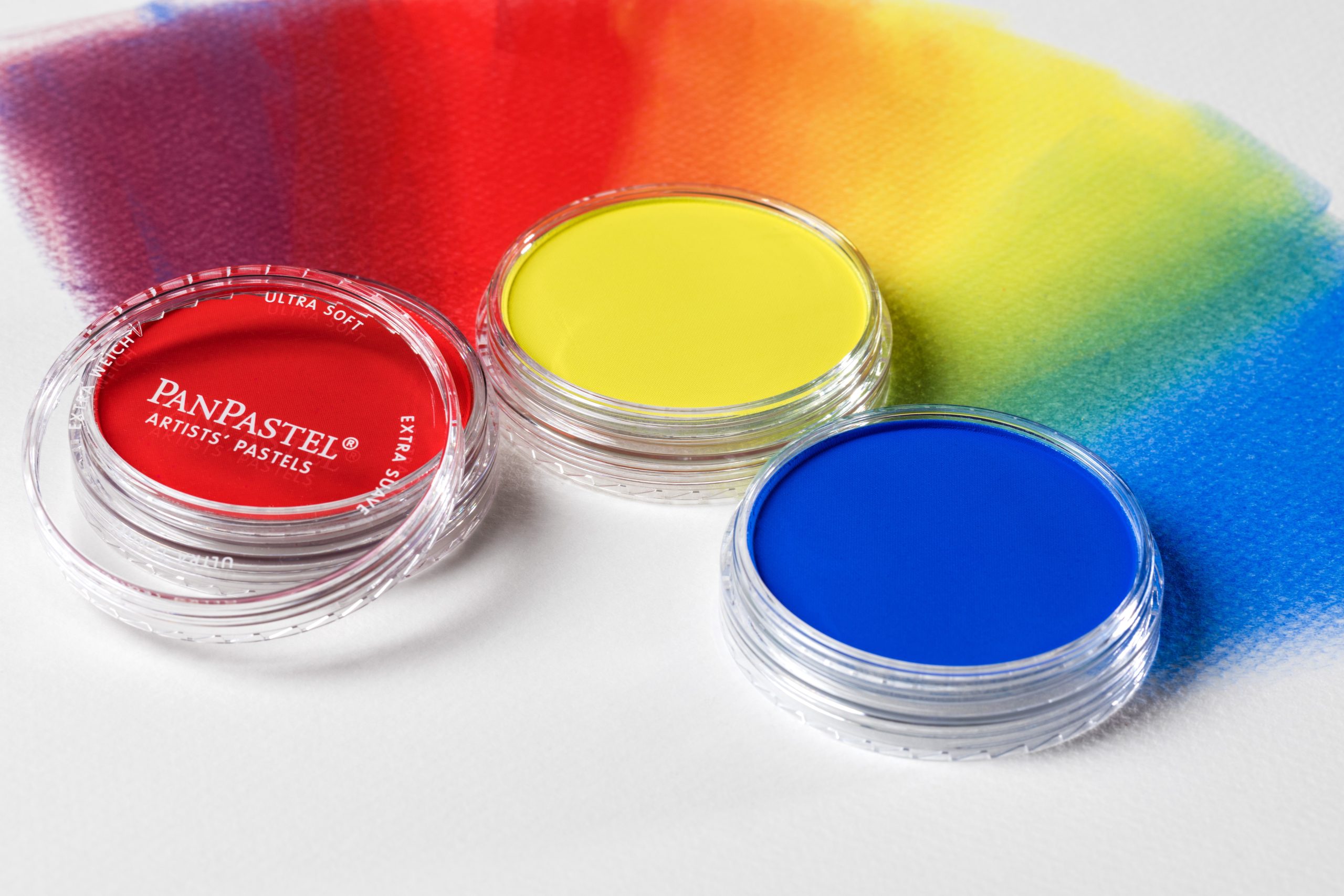
In a previous JustPaint article, we explored the effectiveness of several commonly used spray fixatives to secure PanPastel artwork. Only one was non-aerosol, the SpectraFix Degas, which contains water and alcohol instead of solvents and propellants. This fixative uses a pump-sprayer called the Flairosol, and although this sprayer works quite well, it loses pressure when spraying, creating larger droplets resulting in an uneven, mottled pattern.
To improve the control and atomization uniformity, we used an airbrush to apply a mixture made with GOLDEN Fluid Matte Medium. We’ll review the airbrush, the mixture, the application, and lastly, the test results.
THE EFFECTS OF COATING DRY MEDIA
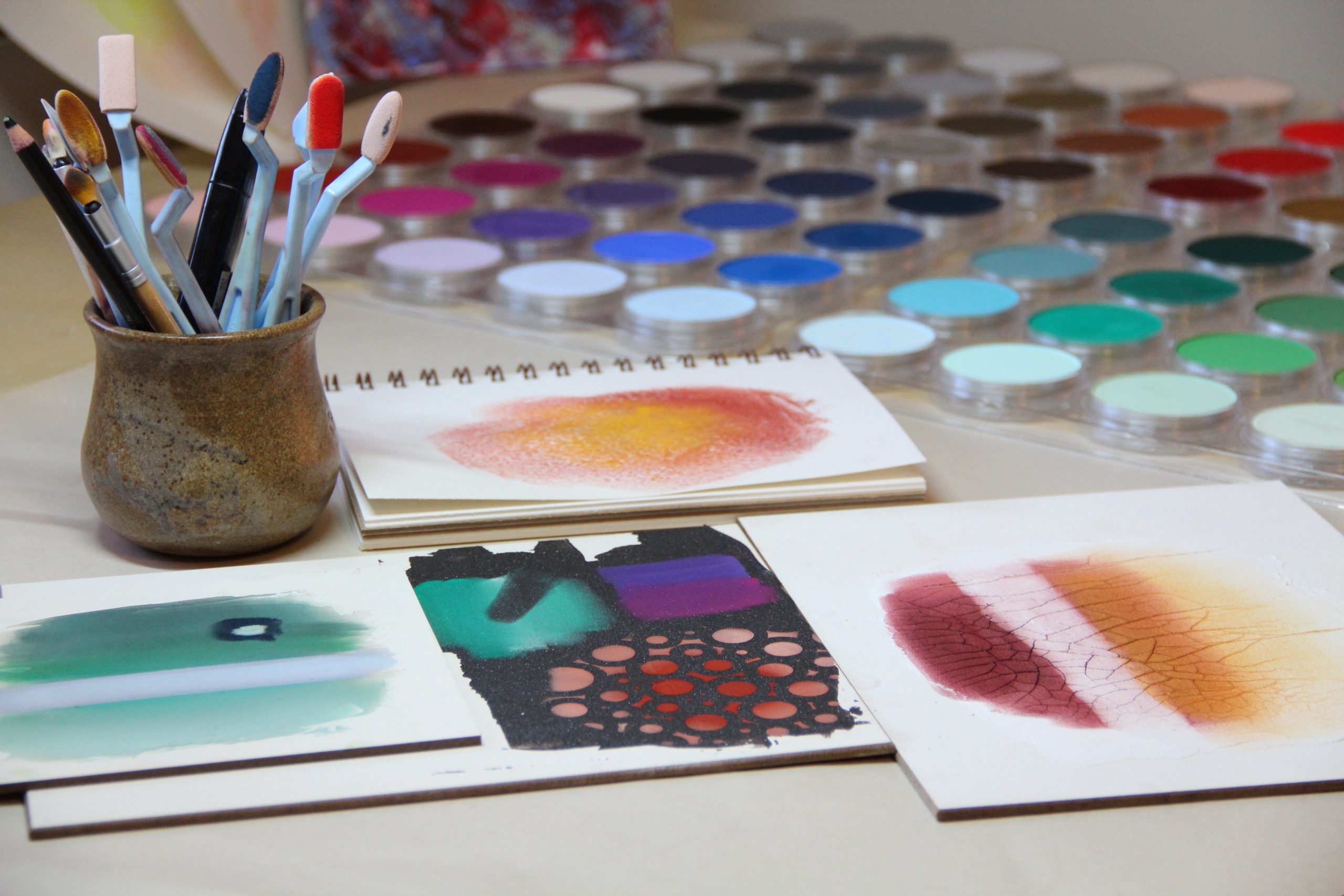
Whenever you apply a protective layer of medium, varnish or fixative to dry media (such as charcoal, pencil and PanPastel colors), there will be changes to what you are trying to protect. In the above-mentioned article, there is often color saturation, or darkening, and increased transparency. This is because a dry material isn’t bound at all, and as the dry solids become coated, there is often a color change. This phenomenon was highlighted in another Just Paint Article about pigment volume concentration (https://justpaint.org/pigment-volume-concentration-and-its-role-in-color/).
Fixatives are mostly comprised of solvents and propellants, and are designed to secure the dry media, with just enough binder to minimize any observable change to the artwork. Coating pastels results in certain colors deepening, while others may increase in transparency. The ultimate goal is to bind the loose particles together just well enough to make them less sensitive when handled.
CHOOSING AN ACRYLIC MEDIUM TO USE AS A FIXATIVE
We chose Fluid Matte Medium because it is already a liquid medium that is easy to thin down into a sprayable consistency, and because its lower sheen should reduce the darkening effect if we were to use a gloss medium. We didn’t want to add Airbrush Medium or High Flow Medium because they would increase the gloss, and they contain retarders and other additives that slow down the drying rate and potentially blur the artwork. Rather, we thinned with water and isopropyl alcohol. Alcohol evaporates readily, which helps speed up drying and minimize changes. A mixture of 4 parts GOLDEN Fluid Matte Medium to 2 parts isopropyl alcohol to 1 part water works well for the test airbrush specifications. This ratio may need to be adjusted in different spray guns.
SPRAY EQUIPMENT USED
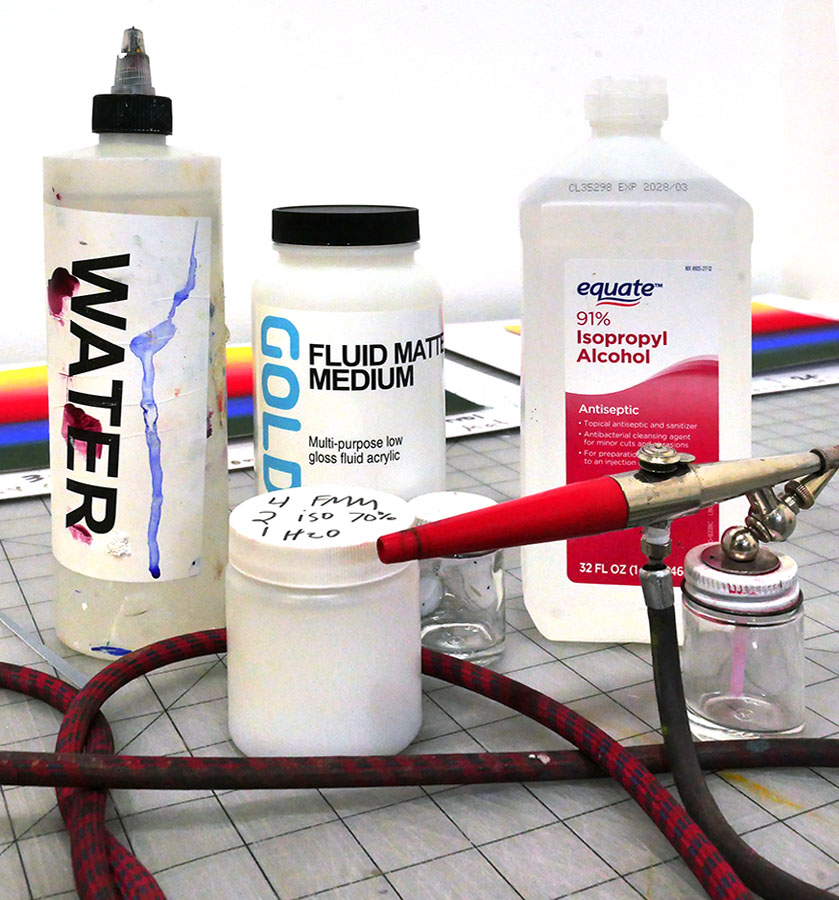
For this testing, we used our trusty and well-worn Paasche Model H, Single-Action Airbrush with the #3 needle assembly. Don’t be fooled by the elaborate name: this is as simple of an airbrush as one can obtain. There are only a few moving parts and it’s easy to clean and operate. The air pressure setting was set at 30psi to reduce blowing the PanPastel particles off the PastelMat paper.
You can certainly use more sophisticated and expensive airbrushes and spray guns for wider patterns that pair well with larger artworks, but this airbrush will work well for this test.
FIXATIVE MIXTURE
The GOLDEN Fluid Matte Medium mixture (4:2:1 ratio – Fluid Matte Medium:91% Isopropyl Alcohol: Water) was sprayed over smooth color gradations identical to those used in the previous article’s testing. The primary change was using a loose mask to cover sections, creating a control section (uncoated), and 1, 2, and 3 applications of fixative. After the layers dried completely, a Sofft Tool Bar Wedge sponge was used to test surface sensitivity.
APPLICATION METHOD
The application technique with an airbrush is similar to other fixatives, where a light touch and multiple light layers are key to minimal color change. Wetter, heavier applications will result in dramatic changes to the color and transparency. Note that the goal is not a varnish-like complete coating. If this is necessary, it is imperative to test every color and media type intended for use to minimize any unforeseen changes.
TEST RESULTS
Below are the results on both PastelMat White and Charcoal color paper.
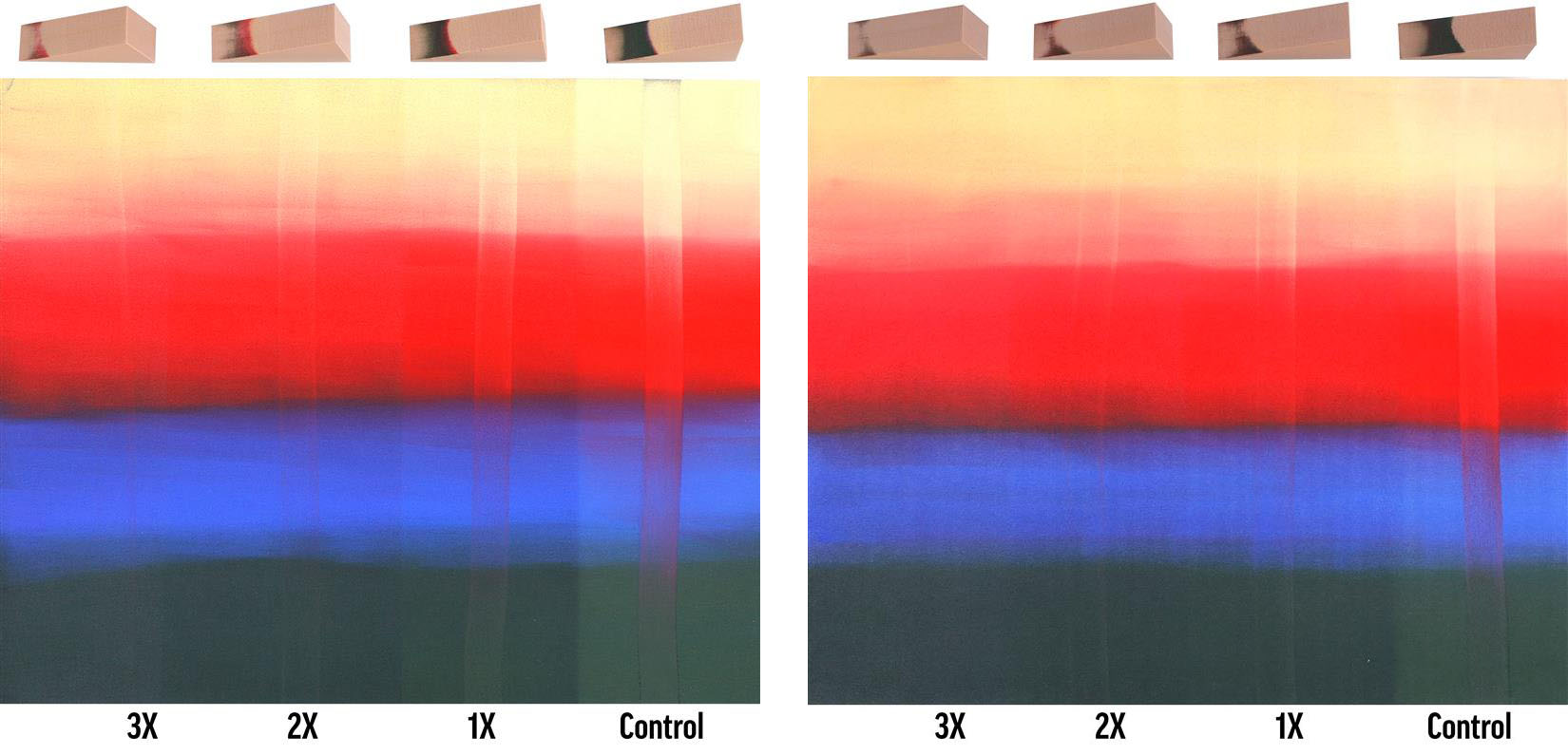
As shown, the initial application results in the most significant color change, with minimal change after the second and third layers. On the third and final layer, the colors appear less saturated, though this may not be fully observable in the test images.
Color sensitivity decreases with each application, as evident on both the PanPastel surface and the Sofft Tool Bar Wedge.
The most noticeable change occurs in the transparency of the Diarylide Yellow Tint PanPastel, particularly on the Charcoal-colored paper stock.

CONCLUSION
The Fluid Matte Medium mixture applied using an airbrush performs within the same range as other commercial fixatives, offering a viable alternative to solvent-based, aerosol-canned versions. It provides greater control and a more uniform application, especially compared to using a Flairosol pump sprayer. If you use the Flairosol sprayer, expect some larger droplets of the mixture to occur.
The selection of Fluid Matte Medium seems to have worked well during this round of testing, but as multiple layers were applied, color desaturation began to appear. This may be due to the matting solids in this product, which could be eliminated by swapping this medium with a gloss medium such as GAC 100.
FINAL PRECAUTIONARY STATEMENT
Safety is paramount when creating art. Always use personal protective equipment when working with dry pigments and powders. When using solvents or alcohols, ensure adequate ventilation, access to fresh air, and appropriate respirators or masks. Additionally, solvents and alcohols are flammable, underscoring the importance of exercising caution and common sense in the studio.

Subscribe
Subscribe to the newsletter today!
