
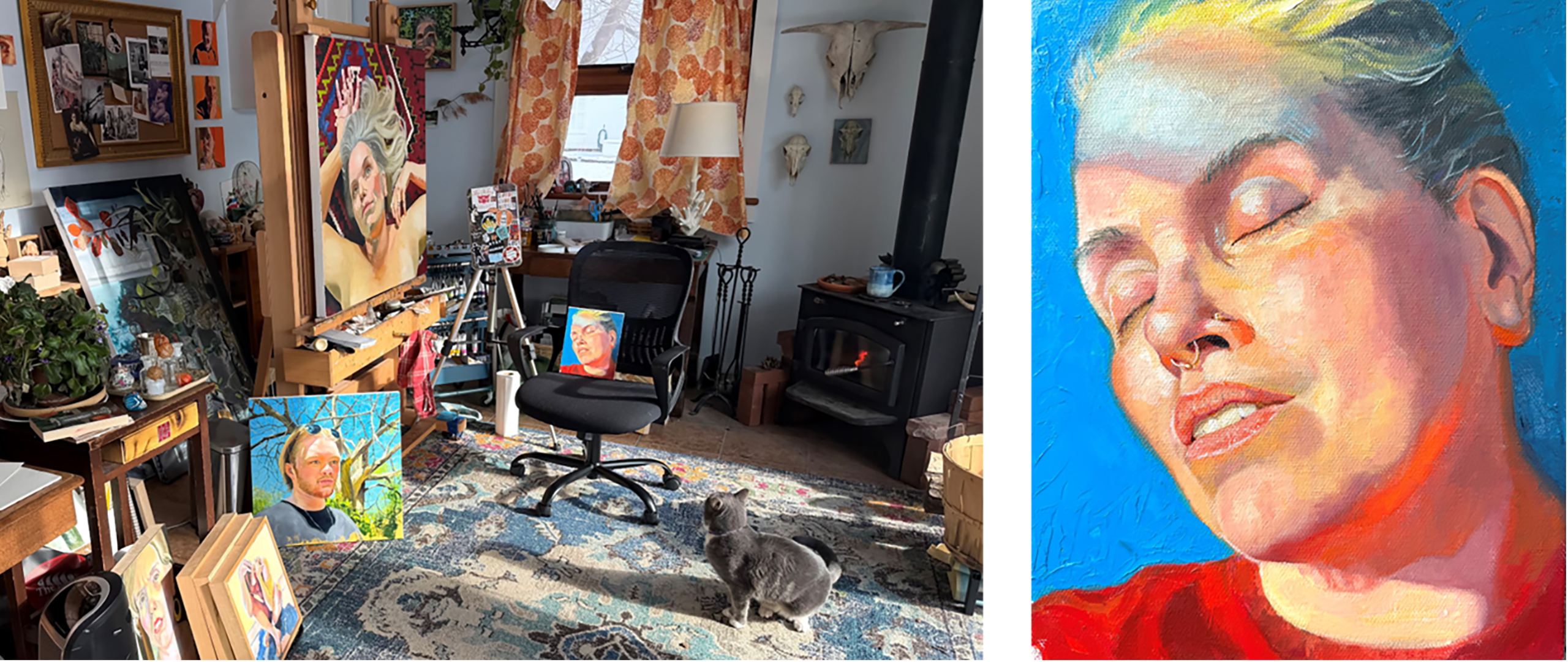
Mark Golden
I am joined today with Ellen, the newest member of our Materials & Application Specialist team here at Golden Artist Colors. These conversations have become one of my favorite parts of Just Paint because they allow our community to meet the exceptional people behind the materials they trust every day.
Our Materials & Application team is filled with artists who not only bring technical expertise, but an infectious curiosity about paint, surfaces, process, and the endless ways artists push these materials. Ellen steps right into that tradition—and we’re delighted to have her.
Ellen, thanks for taking the time to share a bit of your journey with us. Let’s start at the beginning. So, do you remember a moment or maybe a series of moments in your life when you realized art wasn’t just something you enjoyed, but something that you needed in your life?
Ellen Lyon
That’s a great question, Mark. I’ve seen different versions of this question in other artist interviews. So often I hear my own response, which is, I don’t remember a time when I wasn’t making art. I was always drawing. I was obsessed with Garfield. I loved Garfield. I had a book of those comics that I would copy endlessly. And then not long after that, I got a book that had watercolors of fairies and gnomes and that kind of thing. I don’t remember the name of the artist, but I was enthralled and would copy all those endlessly as well. I was always drawing at home and at school. I was the kid that was labeled as the artist in the classroom. I know I share that experience with a lot of other artists. It’s interesting that young children are aware of who is better at drawing and that they respect that skill.
Mark
Right. Were any of your siblings or parents involved in the arts as well? Were they an inspiration or more so just supportive of your own early artistic talents?
Ellen
A little bit of both. They were definitely an influence. I come from a very creative family full of good cooks, woodworkers, and gardeners. My grandfather was a woodworker and taught himself how to quilt. My father was one of my earliest drawing instructors. I would go to him to ask about different things because even though he was a dairy farmer during my youngest years, he had an architectural drawing background. My mom has always been a great supporter of my art career. She has always written poetry and after teaching for decades, retired and learned metalsmithing. I learned from an early age that creativity was part of a healthy life.
Mark
Were there other influences other than your folks who were also mentoring you or influenced you to continue your pursuit of art?
Ellen
I knew no one else who was a professional artist except for my Aunt Kathy. She was a watercolorist and painted professionally for a greeting card company. Other than that, art teachers were the only people I was exposed to that practiced art for a living. Being a professional artist wasn’t readily apparent as a viable path going forward.
Mark
There must have been teachers that noticed your level of talent and interest that they at least encouraged you to really push you forward?
Ellen
Yes! I come from a very small public school. My high school graduating class was 69 students, so small. I had the same art teacher through grade school, middle school, and high school. Her name is Julie Parr. She was fantastic. I’m still in contact with her today. She was and continues to be very supportive and made me feel that making art was worthwhile and special.
Mark
I guess you didn’t have a football team.
Ellen
Ha! No, we didn’t have a football team, but we did have a basketball team. You know, it’s Indiana, so everybody had a basketball team.
Mark
Were there other interests that you were pursuing at the same time?
Ellen
In High School? Yeah. I was a well-rounded nerd and was a very good student. It was very important to me. I was on the academic bowl team. I love Science and History and am still a voracious reader. I just enjoy learning. That sounds a little trite, I don’t know, but I am curious about so many things, a constant learner.
Mark
Was it a difficult journey figuring out what you wanted to do for your college career since you had a diverse level of interests?
Ellen
Honestly, going to art school wasn’t even on my radar. Also coming from a background with a lot of financial insecurity, I was determined that if I’m going to go to college, I’m going to do something practical. So that was part of my mindset. When I went to Indiana University, I started out as a biology major. That lasted maybe half of the semester because I also started that first semester taking a foundational art class. I did not look back.
Mark
Interesting. So how did the family react when you told them, hey, thank you for this really great opportunity at Indiana University and now I think I’m going to become an art major.
Ellen
They were not surprised, and thought it was great. They did not have the college experience that we know now. Dad did a two-year technical degree, and mom went back to get her bachelor’s and master’s after having four kids. So, she had a very non-traditional college experience. I think they were just thrilled to have all four of their children in college, no matter what it took, and encouraged us to follow our hearts.
Mark
So tell me about your college career. What were your studies like? What interests did you go after? Was it all painting or other studio arts?
Ellen
College was an eye-opening experience. Coming from a very small community, I had an idea of what I was missing out on. But then to go just an hour away, which still felt like a big step, to go to this college with 40,000 students was amazing! Being surrounded by the high level of diversity, hearing multiple languages spoken, and the sheer size of the beautiful campus was mind-blowing in the best possible way. It was just wonderful. And it was inspiring to suddenly be surrounded by other people that cared about art as much as I did. I never had that before. It felt as if the clouds parted, the sun shone, and the heavens opened to a brand-new world.
Mark
It is impressive that this change of experience didn’t overwhelm you. So were there other mentors, either faculty or students that continued to inspire you?
Ellen
Yes, there were a few in particular. I earned my first BA in Art History while taking studio courses. I gained confidence to apply to the BFA Painting program. I was accepted and stayed an extra year to finish that degree. I really had some incredible professors, particularly Nancy Barnes. Nancy was fantastic. I had Bonnie Sklarski; she taught anatomy and was instrumental in helping me think about and plan paintings around figures. Even while I’m painting a still life or some landscape, I think when it comes down to it, no matter what it is I’m painting, it’s a portrait. At IU, I also had Barry Gealt, who is an abstract painter, who got us to think about our work conceptually. I feel like I was very lucky to have such a well-rounded experience. And because it’s a big public university, part of that degree was taking such a variety of classes. That variety extended to the arts. I was also able to practice ceramics, printmaking, metalsmithing, and sculpture.
I had not used oil paint until I came to college. So that was a new experience and just blew me away. I enjoy water-based media, but oil painting is and continues to be my true love.
Mark
Pretty wonderful. So, after the BFA, the extra year at IU, what was next?
Ellen
I’ve always maintained a home studio while working full-time. My first job after college was working as a docent at the home and studio of TC Steele, who was an impressionist painter from that area. It was fantastic to have this deep dive into the history of one artist. Learning about his life and sharing it with others got me to begin to envision what I wanted out of my life.
After that I got into picture framing, and I did that for many years in Bloomington and Boston. This started my lifelong obsession with picture frames. When I go to a museum, it’s not just for art, it’s for the picture frames too.
Mark
So many artists struggle with framing, how to mount and how to prepare their work for exhibition. It’s often something that becomes a last thought.
Ellen
Well, exactly. And it really is an additional skill set that I learned on the job. I very much value that training and experience working in a frame shop and later for a museum for so many years.
Mark
Did you ever consider applying to a fine art graduate program?
Ellen
I have considered it many times. The first time was soon after college. I got it in my head that I was going to move to Boston to get a year of residency and then apply to Boston University. And right about that time, let’s see if I can remember my own timeline….as this was all happening, I got engaged. We got married and moved to Boston together. I worked in a frame shop, continued to paint on my own and then applied to BU’s graduate program. I was waitlisted and then got offered a spot after having given up our apartment and packed our moving truck.
After having a family, continuing to paint on my own, and after a decade in my museum career as a Conservation Technician, I once again contemplated earning an MFA. I applied and was accepted into three different low residency programs but then COVID hit the scene.
Mark
So while you’re figuring things out in Boston and continuing to paint, did you have a studio space at home or a separate studio space?
Ellen
Always at home, even in our teeny, tiny fifth floor walkup apartment. While applying to the BU program, I remember meeting with John Walker in his studio. He shared some advice that later became quite prophetic. I shared at the time that I had no interest in teaching and the feedback he shared then, “you just need to work.”
Mark
Bad timing.
Ellen
Yeah. I thought, well I’ve gone too far in this direction. I can’t turn back. So those are the kind of lessons that I really try to pass on to my kids is not making decisions out of fear.
Mark
Life has those other unwritten plans that throw us curveballs and forks in the road.
Ellen
We moved back to be close to family so that we could start our own family and I continued picture framing. Fortunately, the shop had a strong sense of conservation and care for paintings. Some of our clients were the museums on campus and one museum particularly, the Eskenazi Museum of Art. They have a fantastic collection. Staff would come in to buy materials and that is how I found out that there was an opening for a conservation technician. I was hired and stayed in that job for 16 years.
It started by working in the lab, assisting the conservator with treatments and then gradually it grew into training for frame conservation.
Mark
Ellen, you had a chance to visit Artist Colors well before you started working here. Can you talk about that experience, and why you came to Artist Colors? What year was it?
Ellen
I had already been at the museum for probably six years in the position as conservation tech. We attended various conferences and one of them was the Midwest Regional Conservation Guild. They had a meeting that year (~2016) in Cooperstown and we came to the factory for a visit, it was great. You guys had it all set up for us upstairs, I remember. You and the team gave several different talks on conservation, and the group as well gave presentations. I just remember leaving that day and thinking I need to work there.
Mark
What a wonderful collaboration that has been. Our work with art conservators and conservation scientists has been so rewarding. Moving 10 years forward, how did you hear about the job opening here?
Ellen
I saw a listing for the job on the AIC website (American Institute for Conservation). When I read the job description it felt like it was written for me. I remember thinking, “wow, this is my job”!
Mark
This is a pretty unusual job. So, share first, what you thought about coming here and then, about experiencing the craziness of trying to fit into our MAS team.
Ellen
I do love it! I think coming into this role, I understood parts of what the job would entail, but what really surprised me is the extent of testing that is done – just how much testing is done because of material changes that are out of our hands. I was impressed by how important it is to the company to keep up with those changes and to keep the quality as high as possible. It simply requires tremendous effort and resources.
Mark
Given that you’ve already had a chance to work on some projects, which ones have been either most exciting or meaningful for you?
Ellen
I can imagine what my team members would say because there’s been some things that I’ve taken some deep dives into just out of my personal interest and because they aligned with something that was needed. One of those was image transfer.
Mark
OK.
Ellen
Such a fun activity that I had never been introduced to! It is not a highly technical process but one needs to be patient, which I learned the hard way. I thought that was hilarious because I can be impatient at times. If you’ve not done it before, you must give it time and effort. And so, I was determined to figure out image transfer and how to do it well, well enough so that I could teach another person. Staying curious and willing to continue to grow is important.
Mark
It reminds me of the quote often attributed to influential American writer Dorothy Parker: “The cure for boredom is curiosity. There is no cure for curiosity.”
Ellen
Making work requires constant learning and growing though that is not the same as teaching. I’ve not had much teaching experience beyond educating artists about conservation framing and once I got to the museum, some work with students and interns in the lab. Annually, I would teach the graduate assistants on art handling but that was the extent of it. But now to really understand products enough so that you can explain them to another person instead of just understanding them in your own head, taking that extra step, it’s been a new experience and sometimes really challenging.
Mark
Right. The dedication to learning the materials as both an artist but also a Materials Educator demands a deep understanding of all aspects of the products, their uses, and misuse. With that level of working with the materials, has any of this started to creep into your work? Have you found any of that happening?
Ellen
You know, people keep asking me and I’m sure it will. I am thinking about my own studio practice more technically and more thoroughly.
I also love being around and talking to practicing artists on the job. I find it inspiring to be immersed in materials and problem solving with my team, the residents, and artists that contact us. I continue to be a professional, practicing artist and this job often feels like an extension of that rather than my work life being wholly separate.
Mark
Ellen, you’ve been behind the curtains here. What would you want to share with artists that they might not know or understand about our work here?
Ellen
Well, that’s a good question. It is important to me that artists understand that they can contact us directly. I often ask artists if they know that they can just call us? Do you know that we have online resources, like Just Paint articles, that can answer a lot of questions?
I know personally, I would have been intimidated to reach out with an e-mail or phone call. But now being on the other side of it, I hope more artists reach out to us.
Mark
The resource here is really for every artist at whatever level they might be at to take advantage of fellow artists that are here to help and learn.
Ellen
Absolutely. We know that there’s always more for us to learn. The daily conversations we have with artists are incredibly valuable to us and the work that we do. We learn so much from those interactions. Because our entire team is artists, we understand the need for support and a safe place to ask for help. We want to be that safe place. We want to be of service to artists.
Mark
Well, I just want to end by thanking you for joining us and bringing your expertise. But more than expertise, real joy! I think that joy is a centering for all of us. It brings the group together for camaraderie and from that comes a team always willing to do the hard work. While it may be hard, it remains fun every day working with you guys!
Ellen
It is! We are a passionate group. It means so much to us to help fellow artists out in any way we can. I’m happy to be here representing a company I respect. Thanks, Mark!
You can reach out to anyone on our Materials & Application Specialist team at [email protected] when you have questions about products and applications.

