
At Golden Artist Colors we have a team of Materials and Application Specialists who are central to education and developing our product recommendations based on testing and research. As part of our commitment to being a generous resource for artists, this team is available to the public to assist with any materials or application questions that might arise. Artists can reach out anytime through our website, via phone at 800-959-6543 or 607-847-6154, or we can be emailed at [email protected].
After reviewing thousands of questions received from artists over the past six months, we identified the most common categories of inquiries and some corresponding questions and answers. The category we’re focusing on this month is Compatibility.

Ellen:
Can I mix all GOLDEN acrylic products together?
GOLDEN acrylic products are formulated to be compatible. However, keep in mind that each product’s attributes and behaviors will be modified by mixing with others. These attributes include sheen, texture, transparency, viscosity, rheology, and dry time.
For example, there are no compatibility issues with mixing SoFlat Matte with Regular Gel, but the sheen will change. Another example, you can mix Heavy Body paints with your OPEN paints, but the Heavy Body can influence (hasten) the working time of the OPEN. We encourage artists to experiment with combinations of materials to fine tune the attributes listed above without any stability concerns.
Greg:
What do you recommend I use for collaging paper into my oil paint layers?
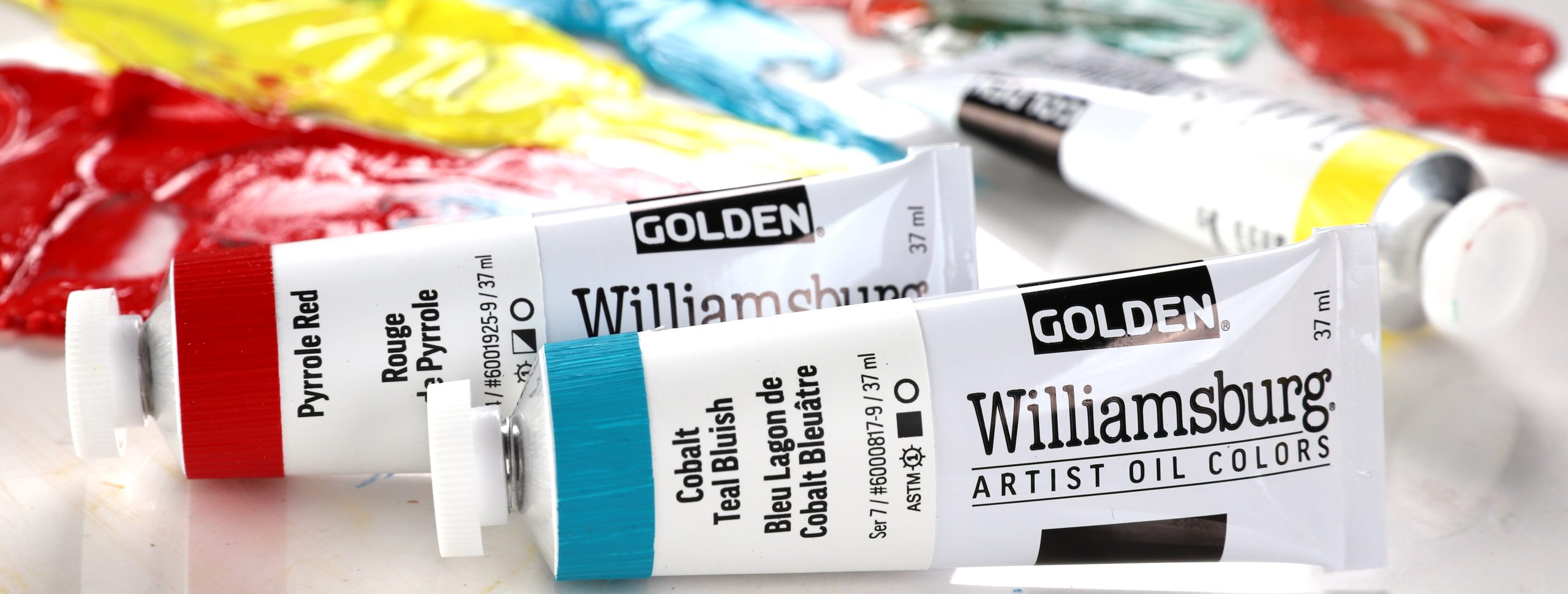
Collaging into oil paintings is an experimental process, as we do not have a time-tested method that we have found to work well consistently. There are several things to consider with this process. The first is protecting the collage element from the oils in the painting and/or the adhesive material itself. The other is what to use to adhere the collage element to the surface and the characteristics of that adhesive.
Most paper collage elements can be treated with Matte Medium to reduce the potential for oil penetration into the paper. Approximately 2-3 coats on both sides and along the edges should reduce the potential for oil penetration and shouldn’t change the look too much. Keep in mind that the binder in Matte Medium can darken some paper or natural fibers, and the matting solids can lighten darker areas. Applying Matte Medium to both sides of the collage element allows for an oil binder or alkyd to be used to adhere the collage element and protects the surface from oil penetration if you want to paint over the collage once it is dried into place.
We are often asked if acrylic can be used as a collage adhesive onto oil paints, but in most cases, we have found this to be advised against. Water-based acrylics do not have good adhesion onto oil paint surfaces. And solvent based acrylics, such as our MSA, contain a rather strong solvent that can soften the underlying oil paint layers, causing a disruption in the curing of that film. While it does seem possible to just bed a collage element right into wet paint as long as the paint is sticky enough, the best solution we have found so far is to use an alkyd medium or an alkyd gel for collaging onto oil paints. The alkyd is a fast-drying durable binder that doesn’t seem to become overly brittle at least in the short term. Williamsburg does not currently make an alkyd medium or gel, but there are several on the market that can be tested for this purpose. As with collage in general, thinner papers can be adhered with a thinner medium, heavier papers may require a more viscous material such as an alkyd gel. Keep in mind that most alkyds contain solvents, so there will be a period while the medium dries where the collage element could be vulnerable to peeling off if it is worked over or abraded. Also, because oils and alkyds dry through contact with air, covering an area with paper will slow drying time and could take a while to fully strap down. If a large area is covered with paper, it could change the expected drying of the underlying oil film in ways that we do not fully understand. Also, alkyds do yellow slightly with time, so areas of straight alkyd left exposed will likely show yellowing, especially if they are thickly applied.
Ideally, collages are made with acrylic products first, then painted over with oils. We have more confidence in collaging with acrylic and it is fine to use oil paints over top of an acrylic collage when you follow our most recent suggestions for using oils over acrylic. Regardless of your method, we recommend you test a new technique on a sample piece to get to know the process before using it on your final artwork. Let us know how it goes.
Cathy:
How much water can I safely add to my acrylic paint?
Using water to dilute GOLDEN acrylics is fine. We have tested up to a ratio of 1-part paint to 100-parts water on a surface of GOLDEN Gesso and found that adhesion of these acrylic washes remained strong. Having a surface at least as absorbent as gesso can help hold highly diluted paint to the surface, much like watercolor paper aids the retention of watercolor washes.
Washes of acrylic also might suffer color lift when painted over with more acrylics. Blending High Flow Medium into the water can help reduce the possibility of pigment lift when working with acrylic washes.
Acrylic diluted with water might bead up on glossier surfaces, and it is possible the addition of the medium to the water will help with this surface tension as well. If you find the paint still beads up, adding a little of the concentrated surfactant Wetting Aid to the water before diluting the paint may help. Wetting Aid should always be added to water before it is introduced to paint.
We would recommend testing the layering of dilutions on grounds to see if everything works as desired. Make notes while testing so changes can be documented, and results duplicated in actual artwork when desired.
See below for links with related information:
- Just Paint, How Much Water Can You Safely Add to Acrylic Paint?: https://justpaint.org/how-much-water-can-you-safely-add-to-acrylic-paint/
- Product Use Information for High Flow Medium: https://goldenartistcolors.com/resources/high-flow-medium
- Product Use Information for Wetting Aid: https://goldenartistcolors.com/resources/wetting-aid
- Just Paint, Stain Painting: https://justpaint.org/stain-painting/
Gordon:
What is the best way to varnish an absorbent surface?
Absorbent surfaces present unique challenges for long-term protection because they can attract and retain contaminants and moisture. High absorbency is often accompanied by a matte sheen and some surface texture, qualities that can be vital to the appearance of the artwork. Any coating is likely to alter these visual subtleties. We recommend displaying your work behind glass when such traits are of the utmost importance.
If you choose to varnish an absorbent surface, we recommend starting by testing some varnish applications on scraps of your preferred substrate with your chosen media applied to the surface. This will allow you to test layering strategies without risking damage to your final artwork.
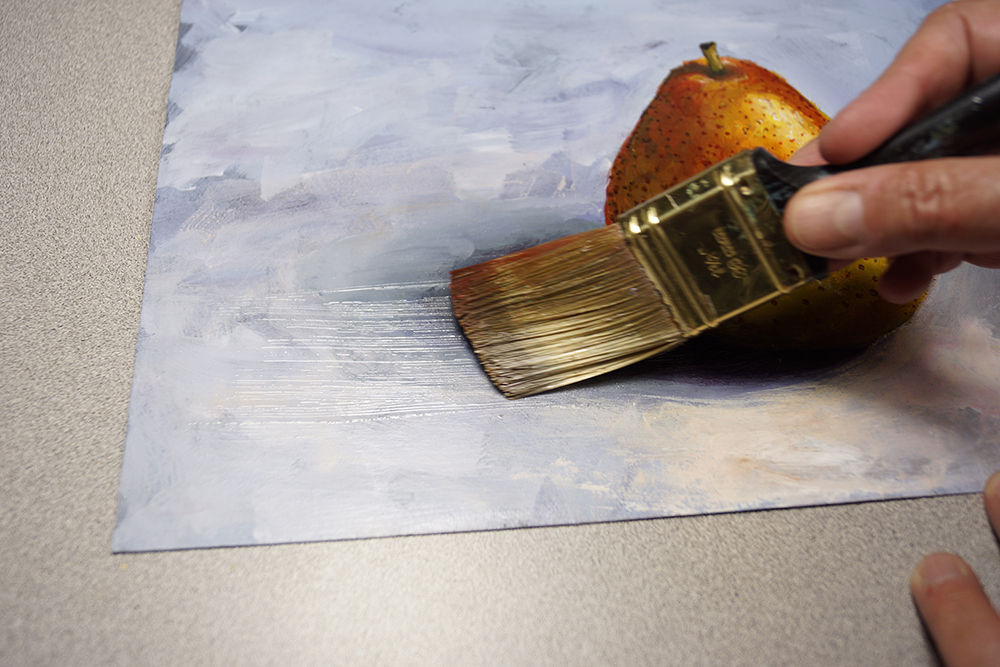
We produce mineral spirit-borne acrylic (MSA) varnishes that are ideal for protection of paintings while still being removable for cleaning by conservation professionals in the future. These varnishes contain a unique blend of UV light stabilizers to reduce the harmful effects of UV radiation. MSA Varnish is both brushable and sprayable depending on the ratio of dilution with MSA Solvent, and it comes in three sheens that can be mixed to achieve any sheen you want. This same formula is also available in a convenient rattle can under the name Archival Aerosol Varnish, which is sold in four sheens.
We find that clarity and color depth is best maintained by applying only Gloss Varnish for all your initial varnish layers. If you prefer a different final sheen, apply Semi-Gloss, Satin, or Matte varnish only for your last layer or two. This method avoids a multi-layer buildup of the matting solids in the off-gloss sheens that can create a hazy or waxy look. Depending upon aesthetic and protection requirements, artists typically apply between two to six light coats of Archival Aerosol Varnish or one to three coats of MSA Varnish. Each coat should melt into the last to create a single film.
We recommend good ventilation and the use of a respirator rated for organic vapor protection during the application and drying of varnish. Very absorbent surfaces can hold onto varnish solvents for days or even weeks, so be sure to maintain ventilation and a fresh air supply during the entire dry time of the varnish.
With acrylic paintings, we recommend applying an optional, nonremovable Isolation Coat and allowing it to dry well before applying varnish. The concept behind isolation coats is the protection of the delicate details below if a conservator is tasked with removal of the varnish layer many years from now. A second benefit of an isolation coat is uniform surface absorbency (which can vary depending upon pigment type). With more consistent absorbency across the surface of the painting, the varnish can have a more consistent sheen with less risk of mottled or patchy areas in the finish. If you do not choose to use Isolation Coat, simply apply additional layers of Gloss Varnish to even out the absorbency of your surface.
We do not recommend an Isolation Coat over oil paints. Varnish can be applied directly over oils/alkyds after a minimum of six months dry time since the last oil/alkyd application. Apply multiple coats of varnish to overcome the absorbency of sunken-in colors or exposed ground layers and create a consistent sheen across the surface.
For works on paper including dry media or watercolors, we recommend applying gloss Archival Aerosol Varnish for your initial layers, finishing with one or two layers in your choice of sheen. Check out this article by our colleague, Cathy Jennings, for more tips on varnishing watercolors.
More varnish information is contained in our Introduction to Varnishing and the follow-up Varnishing Guidelines.
Mike:
What are some options for matching the color space of cadmiums without heavy metals?
Reducing exposure to heavy metals is a valid reason to choose alternative artist grade pigments especially in the yellow to red range. Other artists may want to switch to reduce the cost (cadmiums are very expensive pigments to manufacture). However, tradeoffs include the solid color saturation that makes cadmiums such an important color space.
There are several good alternatives to Cadmium Colors in our paint lines, and some notes on how to match each cadmium color we offer in our Heavy Body Acrylics.
| CADMIUM PAINT COLOR ALTERNATIVES IN ACRYLICS | ||
| Cadmium Color | Alternative Paint Color (Heavy Body Acrylics) | Color Matching Notes |
| Cadmium Yellow Primrose (PY35) | Bismuth Vanadate Yellow (PY184) | Bismuth Vanadate Yellow is a key cadmium alternative because of its opacity. Add Titanate Yellow (PY53) to lighten value and intensity to better match Primrose |
| Cadmium Yellow Light (PY35) | Benzimidazolone Yellow Light (PY175) | Benzi Yellow Light matches the lemony color space but needs Bismuth Vanadate Yellow to increase opacity and lighten value. |
| Primary Yellow | A mixture of two Arylide Yellows and Titanium Dioxide | |
| Cadmium Yellow Medium (PY35) | Cadmium Yellow Medium Hue | A mixture of 3 yellows matching Cad Yellow Medium’s color space. |
| Benzimidazolone Yellow Medium (PY174) | Decent color space match but lacks opacity. Add small amounts of either Titanium White or Bismuth Vanadate Yellow to improve coverage. | |
| Hansa Yellow Opaque (PY74) | A decent match but needs Bismuth Vanadate Yellow to lighten value. | |
| Cadmium Yellow Dark (PY35) | Diarylide Yellow (PY83) | Decent match. |
| Cadmium Orange (PO20) | Vat Orange (PO43) | Add Bismuth Vanadate Yellow to increase opacity and reduce red bias |
| Pyrrole Orange (PO73) | Add Bismuth Vanadate Yellow to increase opacity and reduce red bias | |
| Cadmium Red Light (PR108) | Pyrrole Red Light (PR255) | Add Bismuth Vanadate Yellow to increase opacity and reduce red bias |
| Naphthol Red Light (PR112) | Add Pyrrole Orange to better match Cad Red Light | |
| Cadmium Red Medium (PR108) | Cadmium Red Medium Hue | A combination of two Naphthol red pigments. |
| Pyrrole Red (PR254) | Close color match | |
| Naphthol Red Light (PR112) | Deepen with Pyrrole Red Dark. | |
| Cadmium Red Dark (PR108) | Pyrrole Red Dark (PR264) | Decent match. |
| Naphthol Red Medium | Decent match. |


This is excellent! thanks so much. Especially love the alternative paint color for cadmiums. As my supply of cadmiums dwindles, I’m so glad to have replacements that aren’t scary.