
Our Materials & Application team answers questions from artists daily (via email and phone) and some of the most common questions they receive are related to murals.
In the winter of 2025, Golden Artist Colors invited three accomplished muralists (Nico Cathcart, Colleen Gnos, and Erik Burke) to spend time in residence at the Golden Foundation for the Arts Barn. During their 2-week stay they participated in a three-part interview with artist and founder of O+, Joe Concra. Excerpts from the interviews were pulled out to highlight valuable content from these three experienced artists to share their perspectives and helpful insights.
The interview was broken into three parts. You can watch them separately (listed below) or you can watch them consecutively, giving you the complete discussion.
Part 1: https://vimeo.com/1096233112
Part 2: https://vimeo.com/1096235607
Part 3: https://vimeo.com/1096233373
Below we’ve also indicated where in each video you can find the excerpted text. These are listed prior to the question being asked.
The Business of Being a Muralist
https://vimeo.com/1096235607 10:18
Would you advise someone who might be getting into the mural creation business to intern or go work with someone?
Nico: Yeah. Find someone, and sometimes it means biting your pride, ’cause you’re not going to go out and help an artist and be like ‘okay, I’m going to paint the face today’. You’re probably going to end up priming a bunch of walls and running some errands. But learning about those situations in first person is the best way to learn it.
Erik: Yeah, problem solving in the moment as it’s happening is so valuable. You show up to the site and you’re working in a bad neighborhood in wherever, L.A., could be Reno, and then …. people stole the batteries from the lift last night. You learn that okay, I need to park the lift close enough to the wall so you can’t open the cage to get in there. I’ve got to bring my own master lock and lock this down. Little things that just happen over time.
https://vimeo.com/1096233112 1:26
How do you charge?
Nico: I feel like that’s a complicated question with many, many approaches to it. It’s controversial even among people who have been doing it for a really long time. Personally, I have a good sense of how fast I work, and I need to know a little bit about the scope before I will price it. But I try to think, I know it’s going to take me X amount of hours, this is my hourly, and then calculate my lift, my travel, my whatever, my designing time into that, which is one way of doing it, which would be more complex than doing it another way.
Erik: There are so many variables. It’s so hard. There’s no right way to do it. And I feel like most people now with the internet, just Google, ‘What should I charge for a mural?’ And they’re like, oh, $30.00 to $40.00 a square foot. Which it seems like if you’re entering the mural world, you should start low, work your way up to get you that. Give yourself a raise … you need to do a site assessment. Go there.
You’re like, is the wall raw? Is it primed? Do you want a UV coat? Do you want a graffiti coat on it? And all those things just add so much to the cost of the final product. If you’re entering [the mural business], you probably don’t have that much experience. The wall’s probably really small. It’s probably not supposed to last forever. If you are [just starting], you don’t want it to last forever, you’re like, I hope, I want someone to paint over this in the next couple years because you hope that you’re going to get better.
So, yeah it’s hard. There’s a lot of layers to the onion and you start peeling it back. And now, I think when we first started, or when the hypothetical person’s first starting, you’re trying to secure a wall, you’re kind of shopping around, and then you get to a point where people are shopping the reverse to you, and they come to you. And they almost always have a budget for a project.
About Technique
https://vimeo.com/1096233112 11:02
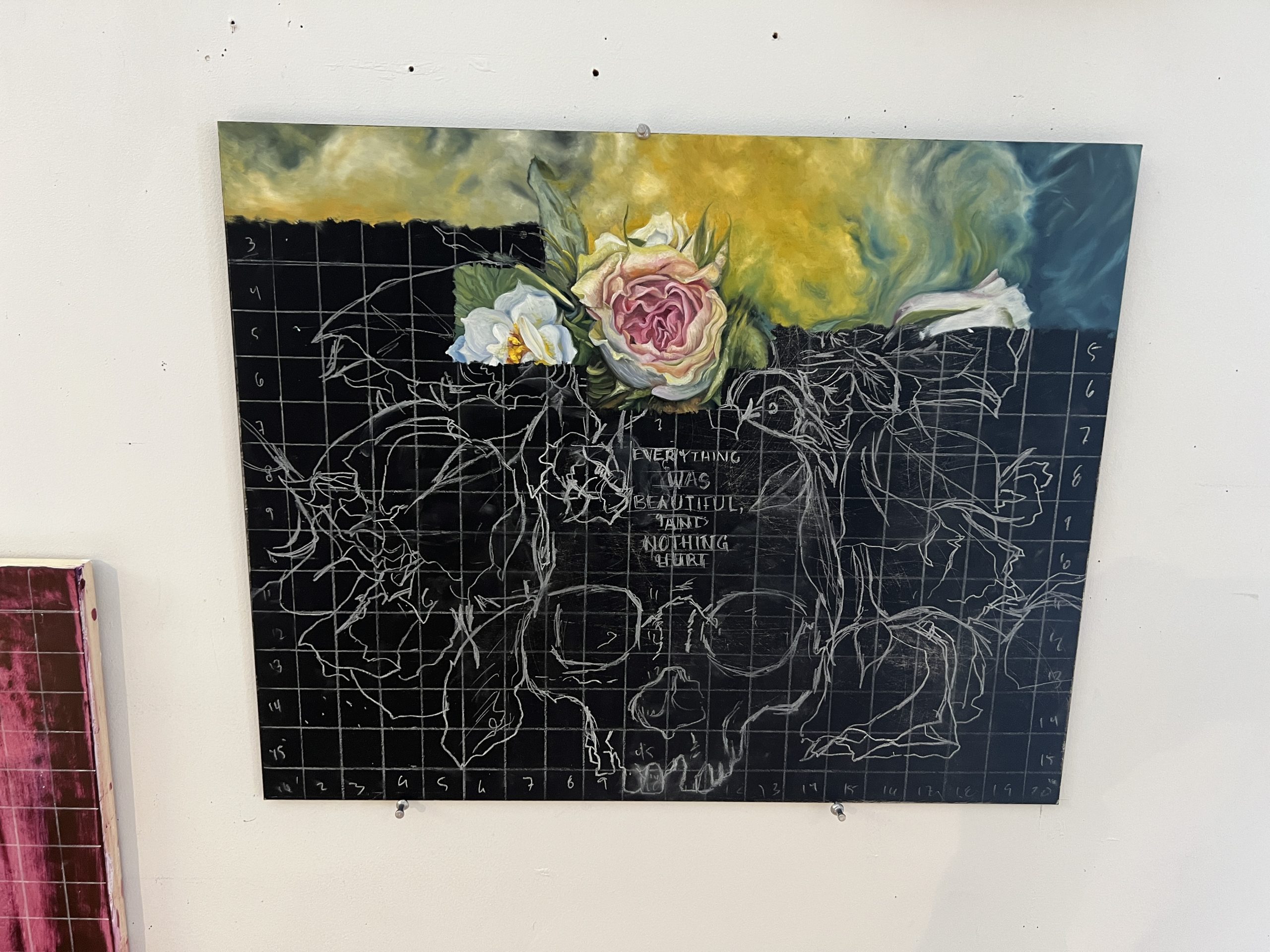
How do you scale up?
Nico: The grid.
Colleen: It is so reliable. I know it’s old school, but I love it so much. So much.
Go off the grid. So, basically you take your sketch … I intentionally make one that’s easy to scale, whether it’s going to scale from one to three inches to one to three feet. You lay out squares, all these squares, and basically you decide, so one inch, this one-inch square, is that going to equal two feet, three feet?
I just have the final size in mind, and then I design it according to that size, and you just basically draw what’s in that little square and it’s amazing. It goes really fast! I feel like I just become more part of the concept and the rendering when I grid out. I don’t like projecting, that’s also another method, but I just feel like it’s on the surface rather than in it, and it can warp. There are problems with it that you may not see until you’re done or in too deep. But the grid is so reliable for me.
Nico: I feel like it gives you the chance to go over it several times. Like you put that grid on. Then you put your line drawing on and that’s the first level. You can start to see proportional issues at that level. And then when you go back through, and you start rendering, you have another opportunity there to correct yourself.
But I like the square because even then, like sometimes you go through all that and you’re doing something really complicated with a weird, like foreshortening or something, and it looks a little off. And so, I can go back on and use sidewalk chalk and put that exact grid back on and then I can look at my giant and be like, oh, I see that small thing that I need to move like an inch on the scale.
https://vimeo.com/1096235607 9:28
Can someone explain poly tab?
Colleen: They call it parachute cloth, but it’s nonwoven cloth, so it’s completely synthetic. And you want to roll on matte medium or your primer thick on one side, so it bleeds all the way through to the backside. But that front side is going to be the surface that you paint on.
Erik: And when you do it, put plastic or a tarp down so that when you peel it off, when it (paint/medium) goes through, it doesn’t stick to whatever your substrate is behind it.
Colleen: Yeah, and you must hang it by clothes pins on a clothesline, and those little clothes pins leave indentations. Anything that gets stuck leaves an indentation – it’s tricky. You let that dry completely and then you can tape it on the wall or whatever surface you’re painting on and then work on it. But you still want plastic behind it because it will become part of the wall. I’ve talked to … a mural conservator, and he conserves murals and frescoes all over the world and they have not been able to get poly tab off a wall.
Erik: Crazy.
https://vimeo.com/1096235607 11:06
So, then once it’s on poly tab, how does it stick to the wall?
Colleen: Well, you roll a gel medium onto the back, a very thick gel medium, and you only want to work with five-foot sections max because they get cumbersome and difficult to work with. And then you get it on the wall, and you want to get all the bubbles (out). Because there’s all these bubbles that build up and then they hold air and gas and that can make the mural fail. But you use Bondo scrapers, and you scrape out all that gel gloss….and then you go in with your fingers, and you massage the bubbles out. If you do get a bubble that’s in there, do a little X-ACTO® blade cut and inject the wall with the medium, so it dries.
About the Paint!
https://vimeo.com/1096235607 3:00
GOLDEN Mural paint is so heavily pigmented. We’ve all used it. All four of us have used it and we love it because of its pigment load. Do you ever have to thin it down so it’s not as pigmented, to get to that translucent and transparency? And is there a color that you can think of that you really would say like ‘oh, that really lends itself to being a transparent color?’
Nico: I use a lot of glazing in my work. It is so heavily pigmented that a gallon lasts forever for me because I just thin it down, thin it down, and I can put thin washes to build up my surfaces. I don’t know about a specific color ’cause it is so beautifully pigmented that it does work like tube paint on the wall. I just use the primaries and burnt umber and white, the same palette for every wall that you’ve ever seen me paint since I discovered this stuff. And it’s just so beautiful to be able to mix up and down and change the color as you go wet-in-wet. And to me it feels like oil on there, ’cause I could just use that medium and create these alla prima layers. Love it.
Optional addition:
https://vimeo.com/1096233373 12:10
We’ve all used heavily pigmented paint and seen how far that gets you. And also, it’s longevity. I mean, obviously you’ve all worked with it, and you see that, but that’s the kind of thing I would say to anybody no matter what, like whether it’s my studio paint, whether it’s something else, you get what you pay for.
Nico: Yep.
Joe: Really does.
Erik: And you could extend it so far.
Nico: I feel like when people complain to me about it, they’re like, ‘Oh, you use that? That seems like it was too expensive. For me, it’s not. Because I have a limited palette, I literally can pull those same gallons through two or three jobs without, necessarily having to reload per se. I would have to get so many gallons of latex to do that.
Colleen: Yeah. So, by spending more, you’re saving money.
Joe: Exactly.
Colleen: It’s really the right tool for the job. So, it’s going to save you time, effort, and gain in the long run.
Nico: Yeah. And it’s consistency too. So, you might have a giant job and you’re using latex, and you get it mixed. You go in, you do the CMYK process and maybe you get five gallons, but it turns out you need an extra gallon. You go back and you get that same CMYK process. Maybe they’re using a different machine. Different. And that’s another cost that adds up.
If you have any materials or applications questions specific to artwork you’re creating, don’t hesitate to reach out to our team anytime at [email protected].

Subscribe
Subscribe to the newsletter today!
